Thursday, April 21, 2022

Blog #8: Trial by Media

Trial by Media: How the Media affects the Outcome of Trial

 Trial by media is a phrase popular in the late 20th century and early 21st century to describe the impact of television and newspaper coverage on a person's reputation by creating a widespread perception of guilt or innocence before, or after, a verdict in a court of law”.

In most cases, this is only relevant when high-profile individuals stand trial, and the impartiality of the jury is potentially compromised by extraneous information that disrupts the due process and leads to an unfair trial.


While doing some research, I found this interesting article that explains how a trial by media affects the right to a fair trial by discussing a case that was highly covered by the media, how the outcome of the trial was affected and how it affected the individual involved.


One thing that I learned from this article that I didn’t know before was that if there has been an intrusion by social media, there may be consequences on legal proceedings that could possibly result in an incapacity to prosecute. Normally those who interfere with the course of justice may be charged with contempt of court, and journalists who report on a case before the court has finished dealing with it are limited in the facts that they can report about.

I think that it is really interesting how times have changed in how someone is punished for Trial by media now compared to the early 90s. For example, the O.J. Simpson case was broadcasted very heavily in the media due to him being a well-known NFL player. Many individuals already had their own point of view on him because he was famous, and these views were good and bad, but the bad began to be portrayed in the media more than the good. Media Coverage began to turn further away from telling the truth and facts about O.J. and the case and instead began to focus on reporting lies. As a result, many of the stories were being published before confirming any of the facts, which resulted in more individuals writing stories who didn’t know what they were talking about in terms of actual court proceedings.


Additionally, another article that I found interesting was one that discussed if a fair trial is possible in this age of mass media. I learned from this article that juries were first introduced in England about 800 years ago, and for one to serve on a jury, it was required that they had to know how was involved in the case and the circumstances of it. 


Over time, the concept of a jury and a trial has changed tremendously to assure fairness, and jurors today are to have little to no knowledge of the case. However, the widespread media changed the concept of the words back to how they were originally defined. Because of the media, jurors are able to know facts about criminal defendants and their alleged crimes before hearing any evidence in court.


It changes everything in the court system, and we don’t realize it. I think back to when I was younger, before I knew anything about Criminal Justice. I remember what I had heard about things on the news or radio, and I never realized how they could paint someone's image on a screen with headlines under it about what they were being accused of. Most of the time, they wouldn’t even have the whole story themselves. From that moment, we all begin to create this image of this person's face who was just broadcasted on the news without even being to hear their story. At that very moment, we all forget the meaning of “Innocent Until Proven Guilty” and the 5th amendment that states “ no one should be deprived of life, liberty, or property without due process of law”. But isn’t this exactly what we're doing when we paint an image of someone in the media before they have even appeared before a judge or jury?


It has become the new norm in the United States that a person is “Guilty Until Proven Innocent” because of the substantial amount of media coverage. We as citizens of the U.S. have to remember the history of why our Amendments were made, and most importantly, I think that sometimes we have to think, what if we were in the other person's shoes, what if our face was all over tv, newspapers, and social media, and we knew that we were innocent. It would tear us apart piece by piece, but the media never covers how it affects the accused and what makes it even more hilarious is that majority of the time, when someone is put away for half of their life, it turns out that they were innocent all along, the media hardly ever covers it because in a way they played a huge role in putting an innocent person away.


Over time, America has become more and more critical of everything because of the role of the media, and we don’t realize it. When we think about all the problems that blew up in the media, we soon begin to realize how often it creates false narratives, but you have to be susceptible to opening your eyes and have a mind of your own to see what is really going on. 

Monday, April 18, 2022

Blog#7: EOTO Reflection (Journo Heroes)

The Life of Frederick Douglas

"Without a struggle there can be no progress." 

- Frederick Douglass


Frederick Douglass was a formerly enslaved man who became a famous abolitionist, author, and public speaker who wanted to end slavery before and during the Civil War. He was born into slavery around 1818 in Talbot County, Maryland. One thing that I found to be really interesting was that he was not really sure of his exact date of birth due to the circumstances of his birth.


At Birth his name Frederick Bailey and when he escaped from slavery he decided to change his name to Frederick Douglass. At the age of six Douglass was taken away from the last of his blood family and sent to live and work on the wye house plantation in Maryland. During his time here he taught himself how to read and write and soon after he started teaching other enslaved people how to read using the Bible.


Years later is 1838, Douglass was able to escape from slavery and arrived in New York at a safe house for abolitionist. After being in New York for some time he found his wife and after getting married, they moved to New Bedford, Massachusetts. 

While in New Bedford, he discovered Lloyd Garrison’s abolitionist newspaper “The Liberator”. This paper inspired Douglass to become the abolitionist, public speaker, and author as we know.


This inspiration led Douglass to many accomplishments including his famous newspaper “The North Star” which was created to promote abolitionist ideas. The paper began in 1847, and covered the injustices of slavery and exposed the country to the horrors of slavery.


As a result, Douglass has became an inspiration to us today because he was able to advocate for those who did not have a voice in multiple different ways, and he helped make this world a better place for those who were at a disadvantage, and for that he will always be remembered in our history.

Sunday, April 17, 2022

Blog #6: Goodnight and Goodluck

we will not walk in fear of one another 
Good Night, and Good Luck.


Goodnight and Good Luck is a movie produced and directed by George Clooney that is based on a true story that “explores the tension between patriotism and treason - between baseless fears and informational integrity - that defined the Red Scare when senator Joseph R. McCarthy accused hundreds of Americans of sympathizing with the communist party” (crimson.com).

This film was able to show how influential the news media is and how it can be used for personal and political gain. During the film we are able to see how afraid people really are afraid of communism and how McCarthy used this as a personal gain. Edward Murrow wanted people to know that there was nothing to be be afraid of, and that McCarthy was just doing all of this in order to gain people’s trust and becoming stronger.

During this time senator Joseph McCarthy exploited the idea that communist were trying to take over. The ideas and lies that McCarthy spread sparked more tension and fear in America. Murrow was not happy about this, so him and his producer Fred W. Friendly decided to step in and challenge McCarthy by exposing him and his lies. They knew that their actions were being used for good, however, their actions got more backlash and began to take a toll on both men and their careers.


After watching this film I honestly think that it is so crazy how individuals can get so much backlash for trying to speak their truth, but also trying to help others in the process. This film shows the real controversy in politics and also standing up for what you believe in, the past and the present.


Someone that I think could really relate to Murrow sticking up for what he believes and speaking his truth is Rosa Parks. I think that they both can relate because she stood up for what she believed in and did not get out of her seat, no matter what the consequences would be or the backlash she might get and she remained fearless.


Additionally, after seeing how fearless Murrow was in the film, I think that more journalist should try to be more like him. In society today we live in an era of social media and this makes it so much easier those people who try to create false narratives in the media. Today we have way more sources of media than there was back in the 1950’s which means news will spread faster but also from multiple different sources. I think that it's time for the media to start being used for good and becoming more fearless and actually speaking the truth with factual information.


Sunday, March 27, 2022

Blog #5: The Life of Mary Ann Shadd (EOTO)

 The Life of Mary Ann Shadd

"IT IS BETTER TO WEAR OUT THAN TO RUST OUT"
- Mary Ann Shadd 


Who was Mary Ann Shadd?


     Mary Ann Shadd was an African American activist, writer, teacher, and lawyer who was born on October 9th, 1823, in Delaware when it was a slave state. At the age of 10, Shadd and her family moved to the free state of Pennsylvania so that she and her siblings could get an education. 

    Her parents were free African Americans who were dedicated to abolitionism, her father worked for an abolitionist newspaper called The Liberator and actively helped freedom seekers

    This introduced Shadd to abolitionism at an early age and led her into a life of activism. Their contribution to helping freedom seekers in the Underground Railroad began to take a downward spiral once Congress passed the Fugitive Slave Act in 1850. This law led Shadd to move to Ontario, Canada to join other African Americans who had also left the US.


Contributions

    During her time living in Canada, Shadd was able to open a school for children of all races. Additionally, she became the first Black newspaper editor after she started her own newspaper, The Provincial Freeman, Canada's first antislavery newspaper. 

    The paper was aimed towards promoting the importance of freedom and encouraging others to begin to move up north as well. Each week Shadd published a new article for African Americans and slaves who had escaped.

     Although she was the founder and the writer of the paper, her name could not be printed on it due to the gender rules and racism increasing during this time. Not only did she play a crucial role in making sure that Black people would have a voice and advocating for women’s rights. 

    But during the Civil war, she moved back to the United States and became a recruiting agent encouraging African Americans to join the fight between the confederacy and against slavery.  to encourage African Americans to move up north for freedom, she also started a racially integrated school for Black refugees.   


Accomplishments

    Soon after the war ended, Shadd moved to Washington DC where she was able to teach in a public school. In addition, she became the first black woman to enroll at Howard University. She graduated in 1870 becoming the first Black woman to receive a law degree in the United States.    

 She soon joined the women’s suffrage movement with Frederick Douglass and Susan B. Anthony by testifying before congress and attempting to vote, and she wouldn’t stop here.

    Shadd was a member of the National Women’s Suffrage Association, and in the early 1870s of January, out of 600 citizens, she was one who signed a petition presented to the House Judiciary Committee, claiming a woman’s legal right to vote. In the late 1880’s Shadd founded the Colored Women’s Progressive Franchise Association, however, this did not last for long. 

    Although her Association was not as successful as she wanted it to be, she continued to use her law degree to help her family, friends, and others of the Black community with legal issues, and equal rights for Black men and women until her death June 1893.


Blog #4: The African American Press and War


THE
 AFRICAN AMERICAN PRESS
 & WAR🤎📰🇺🇸


  For many years before the war, African Americans never had a voice to be able to say how they felt. Many of them had no idea how to read or write because it was illegal for them to get an education. However, in the mid-early 1800s, the abolitionist movement began to form as an effort to end slavery. A lot came behind this movement, and it was the first milestone for African Americans to be free. As time went on and more African Americans were able to start learning how to read and write one tool that many of them used for their voices to be heard was journalism, and as time went on more and more papers about abolitionism, anti-slavery, and the importance of freedom arise.                                                                                                                                            For example, a couple of those papers were The North Starr by Frederick Douglas, The Liberator by William Lloyd Garrison, and The Provincial Freeman by Mary Ann Shadd. Each one of these papers was like fresh air to those who still weren’t free because they knew that they had people that were fighting for them. As time went on and more African Americans were able to start learning how to read and write one tool that many of them used for their voices to be heard was journalism, and as time went on more and more papers about abolitionism, anti-slavery, and the importance of freedom arise. 

    Furthermore, in the 1820’s we see the start of the Black Press which started with the Freedom’s Journal in New York, and over time it became a combination of many other Black newspapers. Additionally, in the 1860s during the start of the Civil war, 40 Black newspapers were being published, and you can best believe that they took advantage of this war with their newspapers to shake some things up. They took this was as an opportunity to free the enslaved.

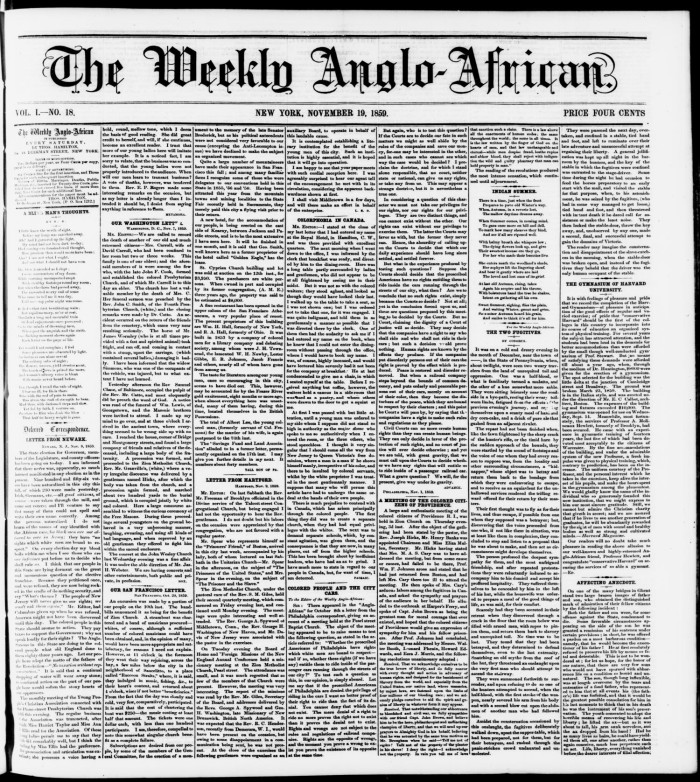
    During this time there were two main papers that were closely following the war and they were, The Anglo-African and The Christian Recorder. Both papers were established in 1859 by editor Robert Hamilton and his brother Thomas and the decision that the Anglo- African would be the paper that would extensively report on the Civil War and the emancipation efforts. Both papers were successful in making more Black New Yorkers want to participate more in debates regarding the war and emancipation, and in the 1860s New York City and New York State became the center of free Black advocacy.
    Black newspapers were not just a source of information for the Black community, but also a source of activism. As the war got closer, The Christian Recorder became a center of debate regarding Black males being accepted to fight with the Union Army. 

    Many believed that it was too risky, and they could risk their liberty because it was still possible, they could be captured and enslaved and the Supreme Court had made it very clear that no matter the circumstance, Blacks were not citizens. On the other hand, The Anglo-African thought it would be logical to use Black troops and promoted this in the papers, and over time more people sided with them.


     Once Blacks became emancipated and congress passed the Conscription Act it was only a matter of time before they would be recruited to fight.

    Of course, there were many whites who were against this, but Black New Yorkers doubled their advocacy for Black troops. Their dedication and advocacy for Black troops were successful and our troops were able to fight for us this wasn’t the end for us fighting and getting what we wanted, it was just the beginning. 


Friday, March 25, 2022

Blog #3: What I learned - Institutions & Publications

 EOTO REFLECTIONS: INSTITUTIONS & PUBLICATIONS


    The first newspaper that I learned about that I thought was interesting was the New York Tribune. The New York Tribune was an American newspaper that was established in 1841 by Horace Greeley. it was also known for being a part of the dominant Whig Party in the mid-1800s. Due to their record-breaking circulation of papers, they played a huge role in shaping the opinion of the U.S. The Tribune provided a variety of different topics which included; political news, special articles, lectures, book reviews, and poetry. With providing so much information to the world the New York Tribune became one of the most know penny paper and one of the biggest players in the journalism world. 


    Furthermore, the second topic that I found to be interesting was the Associated Press, which is a nonprofit organization, a news organizing group that is owned by 1,400 newspapers that are Associated Press members. It was created in 1846 when five New York City newspapers came together to gather funding for a pony express route through Alabama to bring news of the Mexican War. For 170 years The Associated Press has been covering the world’s biggest stories and has continued to stay dedicated to factual reporting and to be the most trusted source for fast, accurate, and unbiased news in a variety of formats, and an essential provider of technology services that known to be vital to the news business.


Saturday, March 19, 2022

Blog #2: The New York Journal (EOTO)

 THE HISTORY OF THE NEW YORK JOURNAL AMERICAN 📰


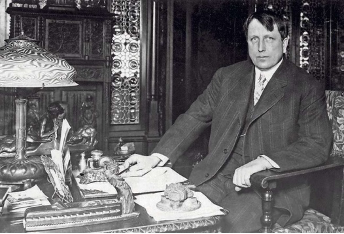
 The New York Journal American was a daily newspaper published in NYC from 1937 to 1966. William Randolph Hearst bought the New York Journal in 1895 when he found a way to hire his rival Pulitzers staff from the Sunday newspaper with the promise of giving them a raise. Hearst and Pulitzer went back and forth trying to win over the staff until Hearst made an offer they could not turn down.

The rivalry between Hearst and Pulitzer grew even bigger when they both decided to publish cartoons based on the “Yellow Kid” Character from Richard Felton Outcault’s comics

 The Journal was the product of a merger between two New York newspapers owned by William Randolph Hearst. The New York American was originally the New York Journal, and in 1901 it was renamed American, which was the morning paper. Soon after came the New York Evening Journal which was an afternoon paper. Both papers were published by Hearst and in 1937, the American and the Evening Journal merged. 

The New York Journal was known for its use of graphics and illustrations and was the most successful American newspaper of the era. The Journal was the earliest American newspaper that gave published credit to its reporters, columnists, editors, writers, cartoonists, and photographers.

The New York Journal was an example of Yellow Journalism. This is the use of lurid features and sensationalized news in newspaper publishing to attract readers and increase publication. 

Through yellow journalism, newspapers competed for readers through bold headlines, illustrations, and activist journalism. The term was coined in the 1890s to describe the tactics employed in the competition between the two most popular NYC newspapers, the New York Journal, and the New York World. 

Due to the many illustrations, colour magazine sections, headlines, articles on crime and pseudoscientific topics, and reducing the price of the paper to only one cent the journal soon began to gain a significant amount of recognition.

The purpose of the New York Journal was to publish, and report exaggerated stories and editorials about the public tensions between the United States and Spain, which eventually triggered a war over Cuba by the sinking of the U.S. battleship Maine in Havana influenced events like the Spanish American War.

While inciting the war with the publications of his paper, Hearst made a statement to his illustrator came up with a quote that became very popular which was “You furnish the pictures, I’ll furnish the war. 

Although the Journal became very popular, this didn’t keep the paper in business. In 1966 the paper ceased publication and donated all the prints used for publication to the University of Texas at Austin in 1968.


Blog #11: Christiane Amanpour (Final EOTO)

  CHRISTIANE AMANPOUR "I NEVER ASSUMED THAT BECAUSE I WAS A WOMAN THAT ANYTHING WAS OFF-LIMITS TO ME." - Christiane Amanpour  Earl...